
Introduction
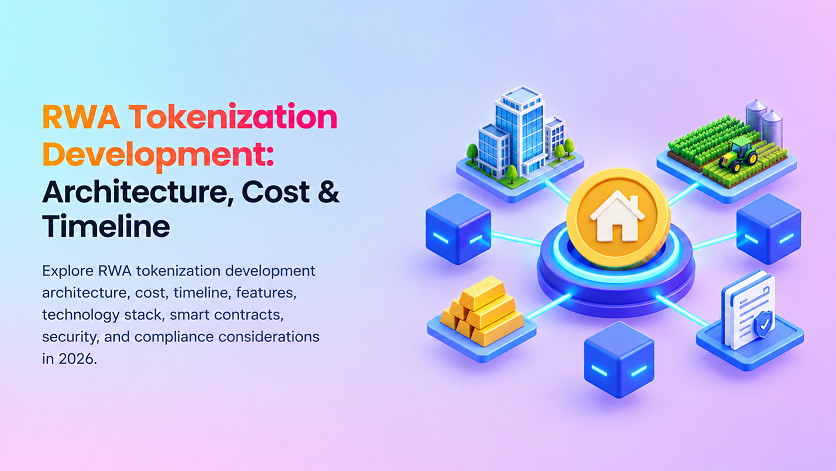
Real-world asset (RWA) tokenization is transforming how traditional assets can be represented, managed, transferred, and settled using blockchain technology. From real estate and private credit to commodities, bonds, investment funds, and other assets, tokenization can create programmable digital representations of traditionally offline assets.
For businesses considering an RWA project, understanding the architecture, development cost, and timeline is essential before investing in the technology.
Unlike a simple token creation project, a production-ready RWA tokenization platform can involve smart contracts, blockchain infrastructure, asset management, investor onboarding, compliance, custody, wallets, APIs, data services, and administrative controls.
In 2026, RWA tokenization development can range from approximately $50,000 for a focused MVP to $500,000+ for an institutional-grade platform, depending on the asset class, platform functionality, compliance requirements, blockchain architecture, and integrations.
This guide explores how RWA tokenization platforms are architected, what they cost to build, how long development takes, and the major technical and business considerations involved.
What Is RWA Tokenization?
RWA tokenization is the process of representing rights or interests associated with a real-world asset through blockchain-based tokens.
Potential tokenized assets include:
- Real estate
- Government and corporate bonds
- Private credit
- Investment funds
- Commodities
- Precious metals
- Infrastructure
- Collectibles
- Intellectual property
- Other eligible financial or physical assets
The token does not automatically make the underlying asset legally transferable or establish ownership by itself. The legal structure connecting the token to the underlying asset is a critical part of the project.
This means successful RWA tokenization development requires both a technical architecture and an appropriate legal and operational framework.
How Does RWA Tokenization Work?
A simplified RWA tokenization process can look like this:
Asset Identification → Legal Structuring → Asset Verification → Token Design → Smart Contract Development → Token Issuance → Investor Onboarding → Distribution/Trading → Redemption
For example, suppose a business wants to tokenize an eligible real estate asset.
The process could involve:
- Verifying the underlying property and relevant documentation.
- Establishing an appropriate legal ownership or investment structure.
- Defining what the token represents.
- Creating the token smart contract.
- Issuing tokens to eligible participants.
- Managing investor records and compliance.
- Allowing transfers where legally permitted.
- Managing distributions or other economic rights.
- Supporting redemption or exit mechanisms.
The technology is only one part of the overall tokenization ecosystem.
RWA Tokenization Platform Architecture
A scalable RWA tokenization platform generally uses a layered architecture rather than putting every component directly on the blockchain.
A typical architecture can be divided into the following layers.
1. User Interface Layer
The user interface is the primary interaction point for investors, issuers, administrators, and other participants.
It may include:
- Investor dashboard
- Asset marketplace
- Portfolio management
- Asset details
- Transaction history
- Wallet connection
- KYC onboarding
- Investment interface
- Issuer dashboard
- Administrative portal
The UI should make complex blockchain operations understandable for users who may not have prior Web3 experience.
2. Application Layer
The application layer contains the platform’s core business logic.
It may handle:
- User management
- Asset management
- Token lifecycle
- Investment workflows
- Eligibility checks
- Compliance rules
- Distribution management
- Redemption workflows
- Notifications
- Reporting
- API services
This layer typically communicates with both blockchain infrastructure and off-chain systems.
3. Tokenization Engine
The tokenization engine is responsible for converting approved assets into blockchain-based representations according to the platform’s defined rules.
It can manage:
- Asset onboarding
- Token creation
- Token supply
- Token metadata
- Issuance workflows
- Token status
- Ownership records
- Transfer rules
A robust tokenization engine can make it easier to support multiple asset classes without rebuilding the entire platform.
4. Smart Contract Layer
Smart contracts implement the blockchain-based rules governing the token.
Depending on the asset and legal model, smart contracts may manage:
- Token issuance
- Transfers
- Ownership records
- Whitelisting
- Transfer restrictions
- Redemption
- Distributions
- Role-based permissions
- Supply controls
- Governance
The exact smart contract design depends on what the token represents and which blockchain is selected.
5. Blockchain Layer
The blockchain provides the decentralized transaction and settlement infrastructure.
Depending on requirements, an RWA platform may operate on:
- Ethereum
- Layer 2 networks
- EVM-compatible chains
- Other high-performance blockchain networks
The blockchain selection should consider:
- Security
- Scalability
- Transaction costs
- Finality
- Ecosystem
- Wallet support
- Institutional compatibility
- Developer tooling
6. Data and Oracle Layer
Not every piece of RWA information exists on-chain.
External data may include:
- Asset valuations
- Commodity prices
- Interest rates
- Property information
- Financial data
- Identity information
- Reserve information
Oracles and trusted data integrations can connect relevant off-chain information with blockchain applications.
The architecture should carefully evaluate the security and reliability of any external data source.
7. Identity and Compliance Layer
RWA platforms often require stronger identity and compliance capabilities than permissionless applications.
This layer can integrate:
- KYC
- AML screening
- Identity verification
- Sanctions screening
- Investor accreditation
- Jurisdiction restrictions
- Transaction monitoring
- Risk scoring
The exact requirements depend on the project’s structure and applicable jurisdictions.
8. Wallet and Custody Layer
Investors need a way to hold and transfer their tokens.
The platform may support:
- Web3 wallets
- Custodial wallets
- Institutional custody
- Multi-signature wallets
- Hardware wallet integrations
The appropriate custody model should be determined by the business model, users, asset type, and compliance framework.
9. Off-Chain Storage Layer
Large documents and sensitive information generally should not be stored directly on a public blockchain.
The platform may use off-chain storage for:
- Legal documents
- Asset records
- KYC information
- Property documents
- Investor records
- Compliance data
- Reports
Blockchain records can contain references, hashes, or other proofs where appropriate.
10. Administration and Monitoring Layer
Administrators need tools to monitor the ecosystem.
An admin dashboard can provide:
- Asset management
- Token issuance
- User management
- Compliance status
- Transactions
- Wallet activity
- Permissions
- Reports
- Platform analytics
- Security alerts
Role-based access controls should be implemented so that sensitive actions are restricted to authorized personnel.
RWA Tokenization Architecture: On-Chain vs. Off-Chain
One of the most important architecture decisions is determining what information should live on-chain and what should remain off-chain.
On-Chain Components
Blockchain networks can store or process:
- Token balances
- Transactions
- Ownership records
- Smart contract rules
- Token supply
- Transfer events
- Relevant proofs or hashes
Off-Chain Components
Traditional infrastructure can handle:
- Personal information
- KYC documents
- Legal agreements
- Asset documentation
- Large files
- Internal business data
- Sensitive compliance information
This hybrid architecture can provide blockchain transparency while maintaining practical data-management and privacy requirements.
RWA Tokenization Development Cost in 2026
The cost of RWA tokenization development depends on the platform’s scope and complexity.
A general estimate is:
| Platform Type | Estimated Development Cost |
| RWA Tokenization MVP | $50,000 – $100,000 |
| Standard Tokenization Platform | $100,000 – $200,000 |
| Advanced RWA Platform | $200,000 – $350,000 |
| Institutional-Grade Platform | $350,000 – $500,000+ |
These figures are indicative software development estimates. Legal, regulatory, licensing, custody, reserve, banking, audit, and other operational expenses may be separate.
Cost Breakdown by Development Component
| Component | Approximate Cost |
| Business Analysis & Architecture | $5,000 – $20,000 |
| UI/UX Design | $5,000 – $20,000 |
| Tokenization Engine | $15,000 – $40,000+ |
| Smart Contracts | $15,000 – $50,000+ |
| Investor Dashboard | $10,000 – $30,000 |
| Issuer Dashboard | $10,000 – $30,000 |
| Admin Panel | $10,000 – $30,000 |
| Wallet Integration | $5,000 – $20,000+ |
| KYC/AML Integration | $5,000 – $20,000+ |
| Marketplace | $15,000 – $50,000+ |
| Security Testing | $10,000 – $50,000+ |
| Blockchain Integration | $10,000 – $30,000+ |
The final cost depends on the number of components required and the complexity of each implementation.
Major Factors Affecting RWA Tokenization Development Cost
Asset Type
Tokenizing one asset class can be simpler than building a platform that supports multiple asset categories.
A multi-asset platform may need different workflows for real estate, bonds, commodities, funds, and private credit.
Token Model
The token’s purpose has a direct impact on the smart contract and platform architecture.
The token may represent:
- Fractional ownership
- Debt
- Fund interests
- Revenue rights
- Asset-backed claims
- Access rights
The legal and economic structure should be established before finalizing the technical design.
Blockchain Network
A single-chain platform may have lower development complexity than a multi-chain ecosystem.
Supporting multiple networks requires additional integration, testing, monitoring, and potentially cross-chain infrastructure.
Smart Contract Complexity
Basic token contracts are less complex than contracts that enforce sophisticated transfer restrictions, investor eligibility, distributions, redemptions, governance, or other business rules.
Compliance
Compliance requirements can have a substantial effect on architecture and development cost.
The platform may need integrations for:
- KYC
- AML
- Sanctions screening
- Investor verification
- Geographic restrictions
- Transaction monitoring
Custody
A non-custodial platform may have different technical requirements from a platform that manages assets on behalf of users.
Institutional custody integrations can add development complexity.
Secondary Trading
Supporting a marketplace is one thing; supporting compliant secondary trading can be considerably more complex.
The platform may need:
- Trading infrastructure
- Transfer restrictions
- Eligibility checks
- Order management
- Liquidity
- Settlement
- Compliance monitoring
Security
The value of assets represented by the platform makes security particularly important.
Security requirements can increase development costs, but they should not be treated as an area for aggressive cost cutting.
RWA Tokenization Development Timeline
The timeline depends on the number of features and the complexity of the underlying asset model.
| Development Stage | Estimated Timeline |
| Discovery & Requirements | 2–4 weeks |
| Architecture | 2–4 weeks |
| UI/UX Design | 3–6 weeks |
| Smart Contract Development | 4–10 weeks |
| Backend Development | 6–12 weeks |
| Frontend Development | 6–12 weeks |
| Integrations | 4–10 weeks |
| Testing & Security | 4–8 weeks |
| Deployment | 1–3 weeks |
A focused RWA MVP may take approximately 3–5 months.
A medium-complexity platform can take 5–9 months, while an advanced institutional platform may require 9–18+ months.
These phases can overlap, so the total timeline is not simply the sum of every phase.
Essential Features of an RWA Tokenization Platform
Asset Onboarding
Issuers should be able to submit asset information, supporting documents, valuations, and other required information.
Token Creation
Authorized users can configure and issue tokens according to the project’s token model.
Investor Onboarding
The platform can provide KYC, identity verification, eligibility, and jurisdiction checks.
Wallet Integration
Users can connect compatible wallets or use supported custody solutions.
Asset Marketplace
An investment portal can allow eligible users to browse available tokenized assets.
Portfolio Management
Investors can view:
- Token holdings
- Transaction history
- Asset allocation
- Distributions
- Investment documentation
- Relevant performance information
Distribution Management
For income-producing assets, the platform may support distributions to eligible token holders.
Redemption
Where applicable, the platform can support token redemption according to the underlying legal and commercial structure.
Transfer Restrictions
Smart contracts and application logic can help enforce eligibility and transfer rules.
Admin Dashboard
Administrators can manage users, assets, tokens, transactions, permissions, compliance, and reporting.
RWA Token Standards
Token standards can play an important role in RWA tokenization architecture.
For EVM-compatible networks, developers may consider standards designed for different types of digital assets and transfer requirements.
Depending on the use case, a project may require:
- Fungible token standards
- NFT standards
- Permissioned or compliance-aware token standards
- Custom token contracts
The appropriate standard depends on what the token represents and what functionality is required.
There is no universal token standard that is automatically suitable for every RWA project.
Security Considerations for RWA Tokenization
Security should be designed into the architecture from the beginning.
Important areas include:
Smart Contract Security
Use comprehensive testing, code review, static analysis, and independent auditing where appropriate.
Access Control
Sensitive functions such as minting, burning, pausing, or administrative changes should have carefully designed permissions.
Key Management
Private keys controlling valuable assets should be protected through appropriate key-management and custody practices.
Oracle Security
External data feeds should be carefully evaluated because incorrect data can affect asset pricing, collateral, or other platform functions.
API Security
Authentication, authorization, encryption, rate limiting, and monitoring should be implemented across application APIs.
Infrastructure Security
Cloud environments, databases, nodes, and other infrastructure should be secured and monitored.
Legal and Regulatory Considerations
RWA tokenization sits at the intersection of blockchain technology and traditional finance.
The legal status of a token can depend on:
- What the token represents
- Economic rights attached to the token
- How it is issued
- Who can purchase it
- Where users are located
- How it can be transferred
- The underlying asset
- Applicable financial regulations
Businesses should obtain qualified legal and regulatory advice before launching an RWA tokenization platform.
Technology alone cannot establish that a token represents legal ownership of an underlying asset.
How to Reduce RWA Tokenization Development Costs
Start With One Asset Class
Rather than supporting every asset category from the beginning, focus on one asset class and validate the business model.
Build an MVP
An initial platform can focus on:
- Asset onboarding
- Token issuance
- Investor verification
- Wallet integration
- Investor dashboard
- Basic administration
- Transfer management
Advanced trading, multi-chain support, and additional asset classes can follow later.
Use Existing Infrastructure
Established blockchain networks, wallet providers, compliance APIs, cloud infrastructure, and development frameworks can reduce development effort where appropriate.
Avoid Unnecessary Customization
Not every component needs to be built from scratch. Reusing reliable infrastructure can reduce both development time and maintenance costs.
Prioritize Security Over Features
It is better to launch a smaller, secure platform than a feature-rich platform with unresolved security risks.
Why Choose Web 3.0 India for RWA Tokenization Development?
RWA tokenization requires expertise in blockchain development, smart contracts, Web3 applications, APIs, security, wallets, and scalable platform architecture.
Web 3.0 India provides blockchain development services for businesses exploring real-world asset tokenization and Web3 applications.
Our capabilities can include:
- RWA tokenization platform development
- Asset tokenization
- Smart contract development
- Token development
- Blockchain application development
- DeFi development
- Crypto wallet development
- Marketplace development
- Blockchain integration
- Private blockchain development
- Web3 development
- Blockchain consulting
- Platform maintenance and upgrades
Our team can develop a solution around your asset type, token model, target users, blockchain network, compliance requirements, and business objectives.
RWA Tokenization Development: Build vs. Buy
Businesses considering an RWA platform generally have several options.
Build From Scratch
This provides maximum control over:
- Architecture
- User experience
- Smart contracts
- Business logic
- Integrations
- Scalability
However, it generally requires more time and investment.
Customize Existing Components
Businesses can use proven blockchain infrastructure and customize the application layer.
This can reduce development time while maintaining control over important platform functionality.
Use a White-Label Solution
A white-label solution can potentially provide a faster path to market.
However, businesses should carefully evaluate:
- Security
- Code ownership
- Customization
- Scalability
- Vendor dependency
- Compliance capabilities
- Upgrade processes
The right approach depends on the long-term business strategy.
Final Thoughts
RWA tokenization development requires significantly more planning than simply creating a blockchain token.
A successful platform combines:
- Legal and asset structuring
- Token architecture
- Smart contracts
- Blockchain infrastructure
- Investor onboarding
- Compliance
- Wallets and custody
- Asset data
- Security
- Administration
- Ongoing monitoring
In 2026, a focused RWA tokenization MVP can cost approximately $50,000–$100,000, while advanced platforms can reach $200,000–$350,000+, and institutional ecosystems can exceed $500,000 depending on scope.
Development timelines can range from 3–5 months for an MVP to 9–18+ months for sophisticated institutional platforms.
The best approach is to begin with a clearly defined asset class, token model, target market, legal structure, and MVP feature set. This allows the development team to design an architecture that can scale without introducing unnecessary complexity at launch.
Ready to build an RWA tokenization platform? Contact Web 3.0 India to discuss your project requirements, architecture, development roadmap, and estimated investment.