


10 Best Metaverse Crypto Projects To Watch Out For in 2023
Everyone has very little or no knowledge about the Metaverse. What does it mean and how does it work? We might not...

Build a scalable ecommerce marketplace where multiple sellers can manage products, customers can discover and purchase from different vendors, and marketplace operators can control commissions, payments, orders, fulfillment and platform operations from one connected system.
Web30 India develops B2C, B2B, C2C and specialized marketplace platforms with seller onboarding, catalog management, multi-vendor checkout, inventory, payments, order management, logistics integrations, analytics and marketplace administration.










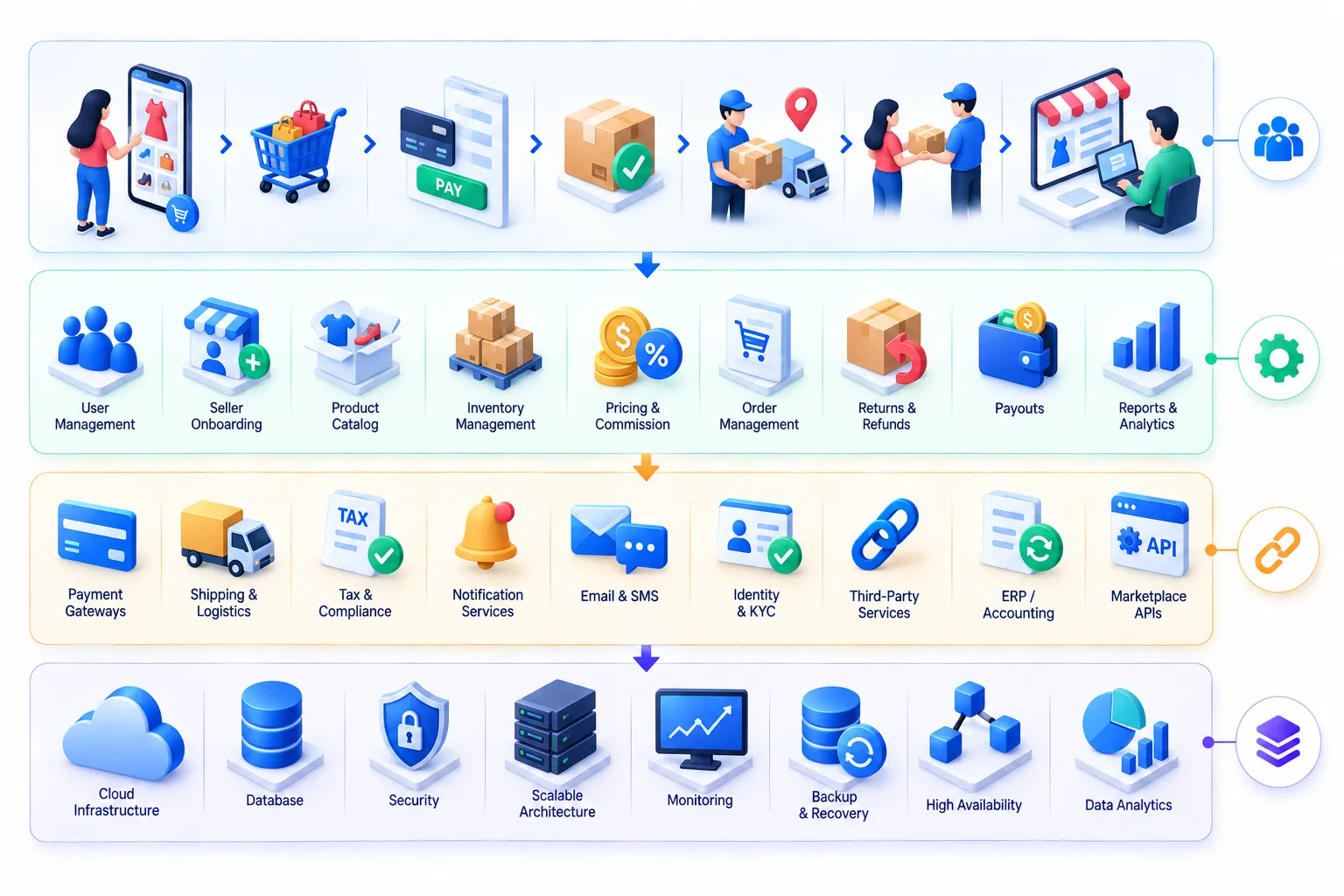
An ecommerce marketplace has more moving parts than a conventional online store. Customers need a simple shopping experience while sellers need tools to manage products, inventory, pricing, orders and fulfillment.
Behind the storefront, the marketplace needs to coordinate seller onboarding, catalog governance, commissions, payment collection, order splitting, seller-specific fulfillment, refunds, returns and payouts.
Web30 India develops marketplace platforms that connect these operations through a centralized architecture, allowing marketplace owners to control the rules while giving sellers the tools they need to operate independently.
Connect multiple brands and sellers with consumers through a shared shopping experience, centralized discovery and marketplace-controlled operations.
Connect manufacturers, distributors, wholesalers and business buyers with catalog, pricing, quotation, bulk ordering and account-based purchasing capabilities.
Enable individuals to list, discover, purchase and sell products through controlled seller profiles, communication, payments and transaction workflows.
Build a specialized marketplace focused on a particular category such as fashion, electronics, healthcare, automotive, food, home products or other niche markets.
Connect local sellers with customers within defined service areas while supporting location-based discovery, inventory and delivery operations.
Bring multiple brands or business entities together under one marketplace while maintaining separate catalogs, seller operations, pricing and settlement structures.
A marketplace brings together buyers, sellers, payments, products and operational data. Security controls need to protect each participant while maintaining clear visibility across transactions and platform activity.
Role-based access for customers, sellers, support teams, finance teams and marketplace administrators.
Protect profiles, addresses, contact information, business documents and other sensitive marketplace data.
Secure checkout, payment processing, refunds, commissions, seller balances and payout-related workflows.
Seller verification, listing approvals, permissions and catalog controls help maintain marketplace quality and trust.
Protect storefronts, seller portals, mobile applications, APIs and connected third-party services.
Track administrative actions, seller activity, transactions, order changes, payouts and other important marketplace events.
Seller registers, provides required business information and completes the marketplace's verification process.
Seller adds products, pricing, inventory and product information for marketplace review and publication.
Customers search products, compare sellers, add products to the cart and complete checkout.
The marketplace identifies seller-specific items and routes the relevant order information to each seller.
Sellers prepare orders while logistics integrations support shipping, tracking and delivery updates.
The marketplace calculates applicable commissions, refunds and adjustments before completing seller settlement and updating transaction records.
A marketplace depends on multiple external systems. Integrations keep product, payment, order, inventory and fulfillment information synchronized across the ecosystem.

Connect payment gateways, wallets, banking services, refunds, split-payment infrastructure and financial reconciliation systems.
Integrate shipping providers, courier networks, shipment tracking, delivery services and fulfillment platforms.
Connect seller ERP systems, inventory platforms, accounting systems, warehouses and enterprise applications.
Integrate authentication, KYC/KYB where required, email, SMS, WhatsApp, push notifications and CRM platforms.
Connect analytics, search, recommendation, reporting and business intelligence platforms for marketplace performance insights.
Bring multiple brands together through one customer-facing commerce platform with independent seller operations.
Connect suppliers and business buyers with account-based pricing, bulk ordering and business purchasing workflows.
Support multiple brands and sellers with catalogs, variants, collections, seller storefronts and personalized discovery.
Manage complex product catalogs, specifications, seller inventory, pricing and fulfillment.
Connect nearby businesses with customers using location-aware discovery, inventory and delivery workflows.
Create a common platform where multiple direct-to-consumer brands can manage their products and reach a shared customer base.
Build category-specific marketplaces around products such as automotive parts, furniture, healthcare products, agriculture, collectibles or other specialized categories.








Understand the target market, seller model, customer journey, commission structure, fulfillment model and business rules.
Define buyer, seller and admin applications, catalog architecture, order management, payment flows, inventory and integration architecture.
Design and develop storefronts, seller dashboards, product discovery, cart, checkout and marketplace administration experiences.
Implement seller workflows, commissions, order routing, fulfillment, payments, logistics and business-system integrations.
Validate checkout, multi-vendor orders, inventory, commissions, refunds, payouts, permissions, integrations and operational scenarios.
Deploy the marketplace, monitor platform performance and continuously improve commerce operations, seller experience and customer journeys.
Insights on ecommerce marketplace development, multi-vendor architecture, seller management, commerce automation, payment infrastructure, marketplace operations and digital commerce.
Everyone has very little or no knowledge about the Metaverse. What does it mean and how does it work? We might not...
Today, smart contracts are beneficial for companies. This in-depth guide goes into great detail about their unique...
Everyone must be aware of how important it is to have a website in order to make a mark in the IT business industry...
Welcome to the next gaming frontier, where virtual worlds collide with reality to create immersive experiences like...
DeFi is an innovative system that will fundamentally change global finance. In summary, DeFi is an open monetary sy...
Everyone has very little or no knowledge about the Metaverse. What does it mean and how does it work? We might not...
Today, smart contracts are beneficial for companies. This in-depth guide goes into great detail about their unique...
Everyone must be aware of how important it is to have a website in order to make a mark in the IT business industry...
Welcome to the next gaming frontier, where virtual worlds collide with reality to create immersive experiences like...
DeFi is an innovative system that will fundamentally change global finance. In summary, DeFi is an open monetary sy...
Everything you need to know about our enterprise blockchain engineering process, costs, security, and architectures.
Where connections are brewed, ideas percolate, and inspiration flows!
Let’s hear about your project. Drop us the details or send us a direct email
 24/7 Support