

10 Best Metaverse Crypto Projects To Watch Out For in 2023
Everyone has very little or no knowledge about the Metaverse. What does it mean and how does it work? We might not...

Build intelligent applications that can read, classify, extract, search and interpret human language across documents, conversations, customer interactions and business data.
Web30 India develops NLP systems around text classification, named entity recognition, sentiment analysis, semantic search, information extraction, summarization, language detection, translation and domain-specific language processing.

Natural Language Processing combines linguistic techniques, machine learning and language models to analyze and interpret human language. NLP can produce structured outputs such as entities, labels, sentiment scores, topics and extracted information that can feed search, analytics and business workflows.








Business information is often stored as emails, documents, support conversations, reports, reviews, contracts and other unstructured text. NLP helps turn that language into structured information that applications can search, classify, analyze and act upon.
Modern NLP systems can perform tasks such as named entity recognition, document classification, sentiment analysis, summarization, key phrase extraction, relation extraction and semantic search.
Web30 India builds NLP solutions around the complete processing pipeline, from text ingestion and preprocessing to model inference, structured extraction, search, analytics and integration with business systems.
Classify documents, messages and other text into predefined categories for routing, filtering, moderation, compliance and business workflows. Text classification can also support sentiment analysis and other language understanding tasks.
Identify people, organizations, locations, dates, products and domain-specific entities within unstructured text.
Analyze the tone and sentiment expressed in customer feedback, reviews, conversations and other text sources.
Extract structured fields, entities, relationships and relevant facts from documents and unstructured content.
Build search systems that understand the meaning and context of queries rather than relying only on exact keyword matches.
Generate concise representations of long documents, conversations, reports and other text collections using extractive or abstractive approaches.
Identify the language of incoming content and connect applications with multilingual processing and translation workflows.
Build systems that locate or generate answers from a given body of information. NLP question answering can use extractive or generative approaches depending on the application.
Extract entities, classifications, key information and relationships from contracts, invoices, forms, reports and business documents.
Analyze support tickets, chats, emails and customer conversations to identify topics, sentiment, intent and recurring issues.
Build search systems that understand user intent and meaning across internal documents, knowledge bases and business content.
Transform large collections of unstructured text into structured insights, categories, trends and searchable information.
Automatically categorize documents, articles, messages and other content according to business-defined taxonomies.
Extract entities, relationships, concepts and structured facts from large volumes of textual information.
Build applications capable of processing content across multiple languages for global users, operations and content workflows.
Connect language understanding with workflows that route, prioritize, classify or process information automatically.
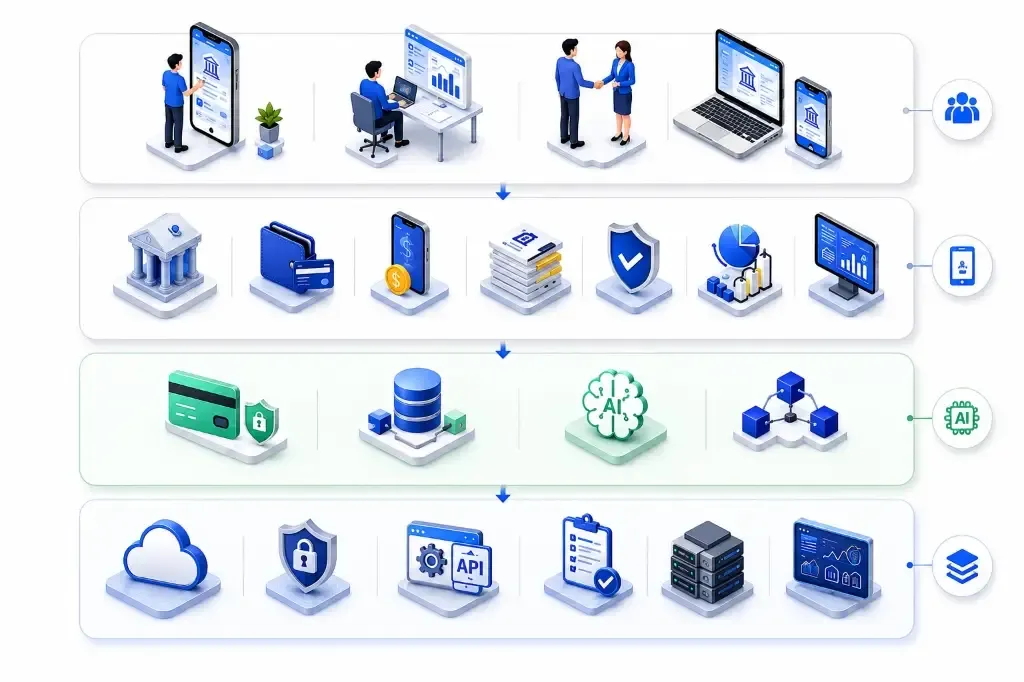
A production NLP architecture combines data ingestion, text processing, language models or task-specific models, structured outputs and application workflows.
Different NLP problems require different modeling approaches. Traditional statistical techniques, machine learning models, transformer architectures and language models can all have a role depending on the data, task and production requirements.
Train models to assign categories to documents, messages or other text inputs. Common applications include sentiment analysis, spam detection and topic classification.
Assign labels to individual tokens for tasks such as named entity recognition and part-of-speech tagging.
Represent sentences or documents as vectors that can be compared for semantic similarity, retrieval and clustering.
Determine how closely two pieces of text relate in meaning rather than simply comparing matching words.
Develop systems that extract or generate answers from provided context.
Reduce long documents, conversations or reports into shorter representations while preserving relevant information.
Adapt NLP models and processing pipelines for specialized terminology, document formats, business rules and industry-specific language.
The quality of an NLP system depends on how language data is collected, cleaned, represented and evaluated before it reaches the model.

Gather documents, conversations, reviews, emails, knowledge bases and other relevant language sources.

Convert supported documents and content sources into machine-readable text.

Detect languages, normalize content, tokenize text and prepare inputs for downstream NLP models.

Create datasets with classifications, entities, intents, relationships or other task-specific annotations.

Create suitable representations using statistical features, embeddings or pretrained language-model representations.

Train or adapt models using representative datasets and clearly defined objectives.
Measure extraction accuracy, classification performance, search relevance and other task-specific metrics.
Use representative production data and evaluation results to refine models and processing pipelines over time.
Control access to documents, conversations, datasets and other textual information.
Restrict access to NLP applications, datasets, models, APIs and administrative functions.
Protect model files, embeddings, inference services and model configuration.
Detect and control sensitive information before it is stored, indexed, analyzed or exposed to downstream applications.
Validate extracted entities, classifications and generated responses before they trigger business actions.
Track model versions, data access, inference activity, system events and relevant administrative actions.
Connect NLP pipelines with document repositories, databases, data lakes, knowledge bases and business content.
Analyze customer interactions, support cases, feedback and communication histories.
Process contracts, invoices, reports, forms and other document collections.
Connect NLP with Elasticsearch, OpenSearch, vector databases and semantic retrieval infrastructure.
Process emails, chat systems, support platforms and communication channels.
Send classifications, extracted entities, detected intents and language insights into downstream workflows and enterprise applications.
Analyze customer conversations, reviews, support requests and feedback to understand recurring issues and customer sentiment.
Process financial documents, extract entities and support document classification, risk analysis and compliance workflows.
Analyze clinical and administrative text to extract relevant entities, concepts and structured information from healthcare documents.
Process contracts, policies and regulatory documents to identify entities, clauses, topics and relevant information.
Analyze product reviews, customer feedback, product content and support interactions.
Classify content, extract topics and entities, improve discovery and organize large content libraries.
Collect text from documents, applications, conversations, databases or other sources.
Extract, clean, normalize and prepare language data for processing.
Apply classification, entity recognition, embeddings, sentiment analysis or another task-specific NLP model.
Identify entities, topics, intent, relationships, sentiment or other meaningful language signals.
Validate model outputs and apply business rules, confidence thresholds and workflow conditions.
Send structured results into search, analytics, dashboards, notifications or automated business workflows.

Define what the system needs to understand, extract, classify, search or analyze.
Review available documents, conversations, languages, data quality and domain-specific terminology.
Select suitable processing methods, models, embeddings, search architecture and deployment environment.
Build processing pipelines, annotation workflows, datasets and task-specific models.
Evaluate extraction quality, classification performance, search relevance and behavior across representative language samples.
Connect NLP outputs with enterprise applications, search systems, analytics platforms and business workflows.
Deploy NLP pipelines and models through APIs, cloud infrastructure, enterprise environments or suitable edge and on-premise infrastructure.
Monitor model quality, processing performance, language coverage and production behavior, then refine the system as requirements evolve.


Explore practical insights on Natural Language Processing, text classification, named entity recognition, semantic search, document intelligence, sentiment analysis, language models, embeddings, multilingual NLP, information extraction and enterprise language applications.
Everyone has very little or no knowledge about the Metaverse. What does it mean and how does it work? We might not...
Today, smart contracts are beneficial for companies. This in-depth guide goes into great detail about their unique...
Everyone must be aware of how important it is to have a website in order to make a mark in the IT business industry...
Welcome to the next gaming frontier, where virtual worlds collide with reality to create immersive experiences like...
DeFi is an innovative system that will fundamentally change global finance. In summary, DeFi is an open monetary sy...
Everyone has very little or no knowledge about the Metaverse. What does it mean and how does it work? We might not...
Today, smart contracts are beneficial for companies. This in-depth guide goes into great detail about their unique...
Everyone must be aware of how important it is to have a website in order to make a mark in the IT business industry...
Welcome to the next gaming frontier, where virtual worlds collide with reality to create immersive experiences like...
DeFi is an innovative system that will fundamentally change global finance. In summary, DeFi is an open monetary sy...
Everything you need to know about our enterprise blockchain engineering process, costs, security, and architectures.
Where connections are brewed, ideas percolate, and inspiration flows!
Let’s hear about your project. Drop us the details or send us a direct email
 24/7 Support