
10 Best Metaverse Crypto Projects To Watch Out For in 2023
Everyone has very little or no knowledge about the Metaverse. What does it mean and how does it work? We might not...

Build language-driven applications that understand context, generate responses, work with business knowledge and connect with real-world systems.
Web30 India develops LLM-based applications around foundation models, prompt and context engineering, RAG, model customization, inference infrastructure, AI agents and enterprise integrations.
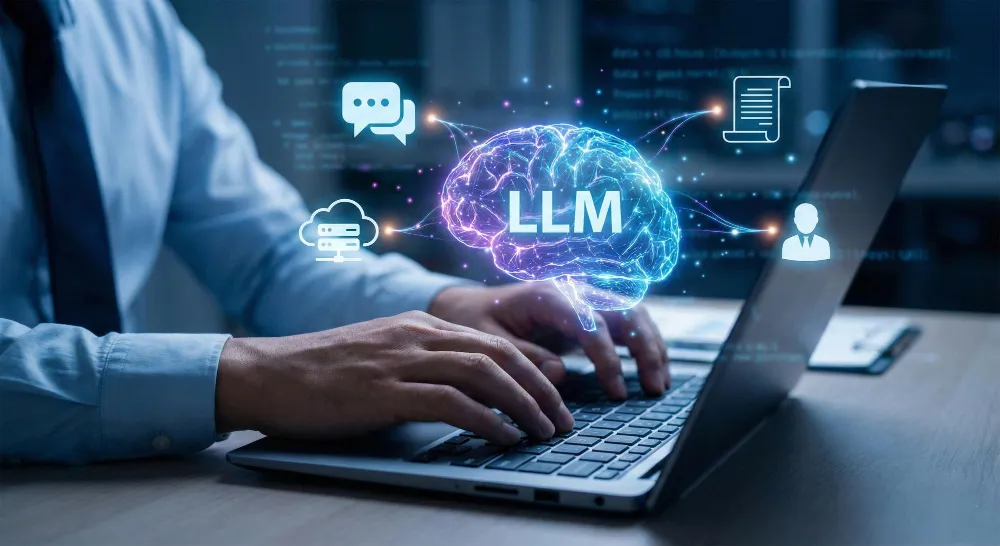
Large language model applications can be built using hosted foundation models, open-weight models or customized models, depending on application requirements such as capability, latency, cost, privacy and deployment environment. Modern platforms also provide model customization, RAG, evaluation and model routing capabilities.










An LLM provides language understanding and generation capabilities, but a production application needs much more around it. Context management, retrieval, prompts, data access, tool integrations, evaluation, security and inference infrastructure all influence the quality of the final system
Web30 India builds LLM applications around the complete application architecture, selecting the right model and connecting it with business knowledge, workflows and enterprise systems.
For knowledge-intensive applications, retrieval can provide proprietary or current information as context to the model. RAG architectures typically combine document processing, embeddings, retrieval and generation to ground model responses in relevant information.
Build applications that use language models for conversational experiences, content generation, summarization, analysis and knowledge workflows.
Integrate commercial and open models through APIs, model gateways and application-specific inference layers.
Customize supported models for specialized tasks using approaches such as supervised fine-tuning and other model customization techniques.
Connect LLMs with enterprise documents, databases and knowledge bases through retrieval pipelines that provide relevant context during generation.
Design structured prompts, system instructions, context windows and response formats around specific application requirements.
Connect language models with approved tools, APIs, retrieval systems and business workflows to support multi-step tasks.
Design model-serving and inference architectures around latency, throughput, scalability, availability and operating cost.
Evaluate model responses for groundedness, relevance, completeness, correctness, safety and application-specific performance.
Build internal assistants that work with company knowledge, policies, documents and approved business systems.
Create conversational knowledge systems that retrieve, organize and summarize information from large collections of business data.
Develop LLM-powered support applications that combine conversational intelligence with knowledge bases, customer information and business workflows.
Use LLMs to extract, classify, summarize and transform information from contracts, reports, forms and other business documents.
Build contextual assistants inside existing software products to help users search, analyze, create and complete tasks.
Combine semantic retrieval and language generation to create conversational search and knowledge discovery experiences.
Build language applications tailored to specialized terminology, workflows, documents and business requirements.
Connect LLMs with APIs and business workflows to automate language-heavy operational tasks.
A production LLM application is typically a system of interconnected components rather than a direct model API call. Retrieval, prompts, application logic, tools, evaluation and infrastructure determine how the model behaves within a specific workflow.
LLMs have broad pretrained knowledge, but enterprise applications often need access to private, changing or domain-specific information. RAG retrieves relevant information from an external knowledge source and provides it to the model as context.
Connect documents, databases, knowledge bases and approved information sources.
Clean, normalize, classify and divide source information into retrieval-ready content.
Create numerical representations that allow content to be searched based on semantic similarity.
Use vector, keyword or hybrid search to identify relevant information for each request.
Combine retrieved information with system instructions, conversation history and application rules.
Send the structured context to the selected language model to generate the response.
Measure groundedness, relevance, completeness and correctness to improve the retrieval and generation pipeline.
Not every LLM application needs model training. Some requirements can be addressed through prompts, retrieval and application logic. When a model needs more specialized behavior, supported customization methods can include supervised fine-tuning and other training approaches.

Adapt supported models toward specialized terminology, domain language and industry-specific requirements.

Train models using examples that demonstrate the desired input and output behavior.

Optimize model behavior for specific application tasks such as classification, structured generation or response formatting.

Improve consistency around tone, structure, formatting and application-specific response patterns.

Use model customization and distillation approaches where a smaller model is appropriate for a particular production workload.

Compare the customized model against a defined evaluation set before introducing it into production.
Restrict which users and AI workflows can access specific enterprise information.
Establish controls against malicious instructions, prompt injection and unintended context exposure.
Protect model credentials, API keys, endpoints and inference permissions.
Validate generated responses before they are displayed, stored or used in downstream workflows.
Control which APIs, databases and business functions an LLM can access.
Track requests, model usage, retrieval activity, tool calls, errors and relevant operational events.
Give employees conversational access to approved internal knowledge and documentation.
Automate information-heavy customer conversations while connecting responses to approved knowledge sources.
Extract, summarize, classify and transform information from large volumes of business documents.
Support code generation, documentation, testing, debugging and developer workflows.
Retrieve, compare, summarize and organize information for research-intensive processes.
Assist with content creation, editing, summarization, translation and transformation.
Embed contextual language assistance into applications used by employees and professional teams.
Connect LLMs with APIs and business systems to automate language-driven operational processes.
Databases, data warehouses, document repositories and internal knowledge systems.
CRM, ERP, HRMS, support, finance and operational platforms.
Vector databases, search engines, embedding services and enterprise retrieval systems.
Email, collaboration tools, messaging platforms and customer communication channels.
Internal APIs, third-party services and controlled business functions.
OpenAI, Azure AI, Google Vertex AI, Amazon Bedrock and other model infrastructure.
A user submits a question, instruction, document, image, audio input or other supported information.
The application identifies the task, relevant context and required workflow.
The system retrieves relevant knowledge or determines which approved tools and APIs are required.
The application combines user input, retrieved information, system instructions and business rules.
The selected generative model processes the request and produces the required output.
The application evaluates the response, applies required controls and returns the result or triggers the next workflow step.

Identify the business problem, users, expected outcomes, available data and appropriate role for generative AI.
Evaluate models, modalities, hosting options, retrieval requirements, integrations, latency and cost considerations.
Design prompts, context handling, data pipelines, retrieval strategies and application-specific instructions.
Build the user experience, orchestration layer, model integrations, retrieval system, APIs and business workflows.
Test response quality, groundedness, relevance, correctness, safety, performance and failure scenarios.
Connect the AI application with business systems, data sources, identity providers and approved tools.
Deploy the application, model infrastructure and supporting services with appropriate monitoring and operational controls.
Improve prompts, retrieval, model selection, evaluation datasets, latency, cost and application performance as usage evolves.












Explore practical insights on Generative AI architecture, LLM applications, RAG, multimodal AI, model customization, AI agents, evaluation, enterprise AI and production deployment.
Everyone has very little or no knowledge about the Metaverse. What does it mean and how does it work? We might not...
Today, smart contracts are beneficial for companies. This in-depth guide goes into great detail about their unique...
Everyone must be aware of how important it is to have a website in order to make a mark in the IT business industry...
Welcome to the next gaming frontier, where virtual worlds collide with reality to create immersive experiences like...
DeFi is an innovative system that will fundamentally change global finance. In summary, DeFi is an open monetary sy...
Everyone has very little or no knowledge about the Metaverse. What does it mean and how does it work? We might not...
Today, smart contracts are beneficial for companies. This in-depth guide goes into great detail about their unique...
Everyone must be aware of how important it is to have a website in order to make a mark in the IT business industry...
Welcome to the next gaming frontier, where virtual worlds collide with reality to create immersive experiences like...
DeFi is an innovative system that will fundamentally change global finance. In summary, DeFi is an open monetary sy...
Everything you need to know about our enterprise blockchain engineering process, costs, security, and architectures.
Where connections are brewed, ideas percolate, and inspiration flows!
Let’s hear about your project. Drop us the details or send us a direct email
 24/7 Support