
10 Best Metaverse Crypto Projects To Watch Out For in 2023
Everyone has very little or no knowledge about the Metaverse. What does it mean and how does it work? We might not...

Build AI-powered conversational experiences that understand user intent, work with your business knowledge and connect conversations with real actions.
Web30 India develops AI chatbots for customer support, sales, internal operations, knowledge access and business workflows, combining conversational AI, enterprise data, APIs and intelligent automation.












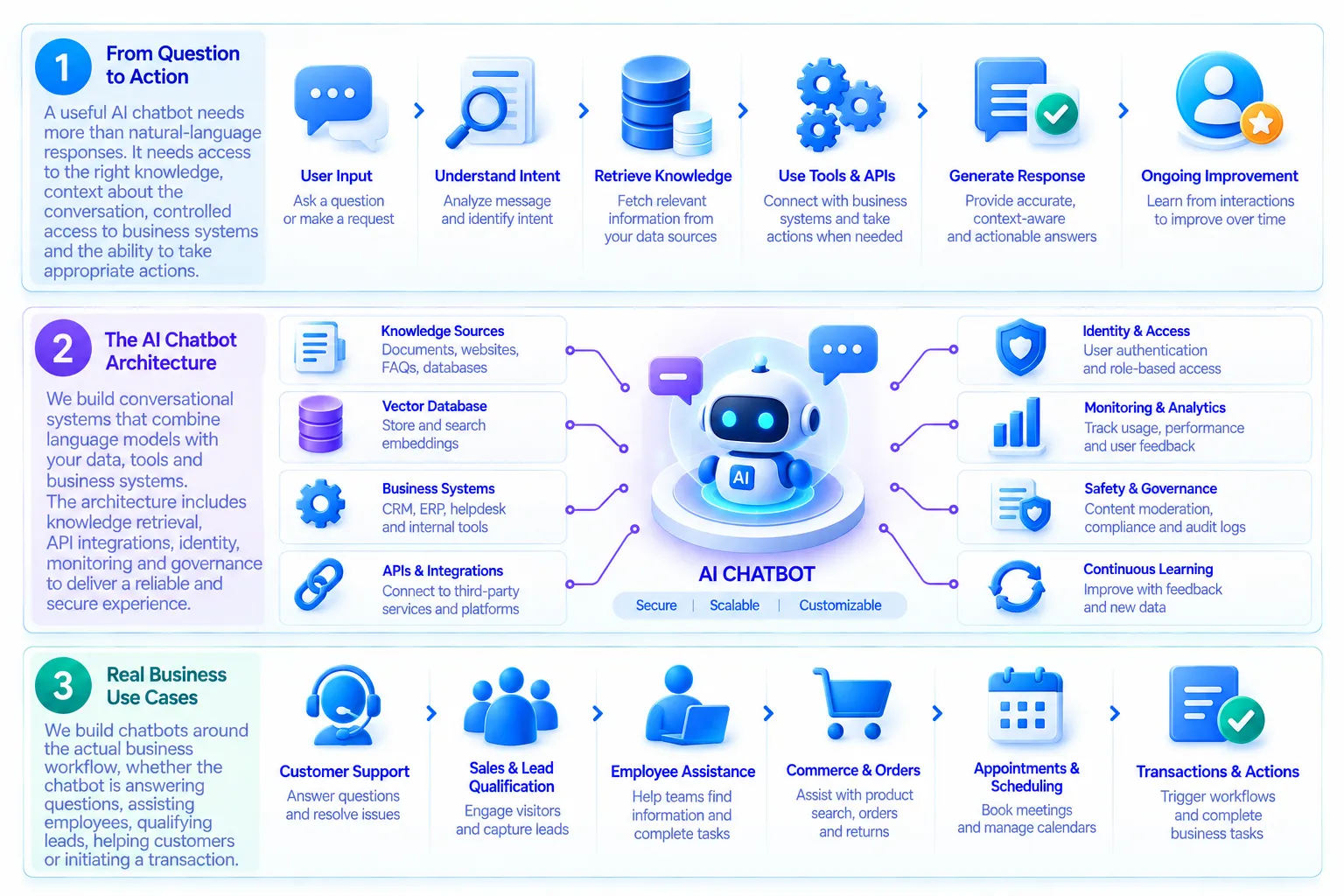
A useful AI chatbot needs more than natural-language responses. It needs access to the right knowledge, context about the conversation, controlled access to business systems and the ability to take appropriate actions.
Chatbots can use retrieval to bring relevant information into a conversation, connect with APIs and business systems, and use tools when a response requires more than generating text. Modern AI application architectures increasingly combine these layers with identity, monitoring and governance.
Web30 India builds conversational systems around the actual business workflow, whether the chatbot is answering questions, assisting employees, qualifying leads, helping customers or initiating a transaction.
Answer customer questions, guide users through common issues and connect conversations with support workflows.
Give employees a conversational way to search internal documents, policies, procedures and business knowledge.
Engage visitors, understand requirements, qualify prospects and connect conversations with CRM workflows.
Help customers discover products, compare options, answer questions and support purchase-related interactions.
Support employees with information retrieval, task assistance, workflow guidance and access to connected business systems.
Extend conversational experiences beyond text with voice, images and other supported input or output formats.

AI chatbot architecture needs to account for the information users can access, the systems the chatbot can interact with and how conversations are monitored.
Authenticate users and control which information, capabilities and actions are available to each user or role.
Apply appropriate permissions when retrieving information from internal documents, databases and enterprise knowledge sources.
Protect conversation data, customer information, uploaded documents and other sensitive application data
Apply controls around user inputs, instructions and potentially unsafe requests before they reach application workflows.
Control which APIs, functions and business operations the chatbot can invoke and validate the data passed between systems.
Track relevant conversations, application events, tool calls, errors and operational activity for analysis and governance.
Control access to chatbot features and connected business functions.
Route conversations to human teams when the chatbot should not continue independently.
Apply validation, business rules and application-level checks before responses or actions reach users. Enterprise AI reference architectures from Microsoft similarly include identity, networking, monitoring, governance and secure connectivity around conversational AI applications.
The user asks a question, describes a requirement or starts a conversation through the selected channel.
The system identifies the user's intent and considers relevant conversation context.
The chatbot determines whether it needs business knowledge, retrieved information or access to a connected tool.
Relevant information is assembled and provided to the AI model to generate an appropriate response.
Application rules validate the response or requested action before connected systems are updated.
The chatbot responds to the user and maintains the relevant conversation state for the next interaction. Modern chatbot APIs can combine model responses with file search, web search and custom tools or functions, making this architecture suitable for knowledge-based and action-oriented conversational applications.

Connect documents, knowledge repositories, databases and structured business information.
Connect customer profiles, lead management, support records and sales workflows.
Connect product catalogs, orders, inventory, customer accounts and commerce workflows.
Deploy chatbot experiences across websites, mobile applications and supported messaging channels.
Connect the chatbot with internal APIs, automation systems and business processes.
Integrate authentication, user identity, permissions and enterprise access controls.
Answer common questions, guide customers through issues and route complex cases to support teams.
Engage website visitors, understand their requirements and collect information for sales teams.
Help employees find policies, procedures, documents and operational information through natural-language conversations.
Help customers discover products, understand specifications, compare options and navigate purchase journeys.
Support customer queries, product information, service requests and selected workflow interactions.
Provide information, navigation and administrative assistance while keeping access and data handling appropriately controlled.
Assist with bookings, property information, travel questions, itinerary support and guest services.
Support learners and staff with academic information, institutional knowledge and learning assistance.





Understand users, business objectives, conversation scenarios, escalation requirements and expected outcomes.
Identify the documents, databases, systems and business information the chatbot needs to work with.
Select the appropriate models, retrieval architecture, conversation design, integrations and deployment approach.
Build the conversational interface, orchestration layer, knowledge retrieval, prompts, business logic and connected actions.
Connect enterprise systems and validate conversations, retrieval quality, tool execution, permissions and edge cases.
Evaluate response quality, access controls, failure scenarios, data handling and application security.
Deploy the chatbot across the selected channels and establish the required production infrastructure.
Review conversations, user feedback, system performance and response quality to continuously improve the chatbot.
Explore practical insights on AI chatbot development, conversational AI, RAG, LLM integration, AI agents, chatbot architecture, enterprise AI, knowledge assistants, AI automation, chatbot security and production AI systems.
Everyone has very little or no knowledge about the Metaverse. What does it mean and how does it work? We might not...
Today, smart contracts are beneficial for companies. This in-depth guide goes into great detail about their unique...
Everyone must be aware of how important it is to have a website in order to make a mark in the IT business industry...
Welcome to the next gaming frontier, where virtual worlds collide with reality to create immersive experiences like...
DeFi is an innovative system that will fundamentally change global finance. In summary, DeFi is an open monetary sy...
Everyone has very little or no knowledge about the Metaverse. What does it mean and how does it work? We might not...
Today, smart contracts are beneficial for companies. This in-depth guide goes into great detail about their unique...
Everyone must be aware of how important it is to have a website in order to make a mark in the IT business industry...
Welcome to the next gaming frontier, where virtual worlds collide with reality to create immersive experiences like...
DeFi is an innovative system that will fundamentally change global finance. In summary, DeFi is an open monetary sy...
Everything you need to know about our enterprise blockchain engineering process, costs, security, and architectures.
Where connections are brewed, ideas percolate, and inspiration flows!
Let’s hear about your project. Drop us the details or send us a direct email
 24/7 Support