
10 Best Metaverse Crypto Projects To Watch Out For in 2023
Everyone has very little or no knowledge about the Metaverse. What does it mean and how does it work? We might not...

Turn repetitive, information-heavy business processes into intelligent workflows that can understand inputs, make decisions, work across systems and move tasks forward with the right level of human oversight.
Web30 India builds AI automation solutions that combine AI models, workflow orchestration, business rules, APIs, enterprise systems and automation tools to improve how work gets done.











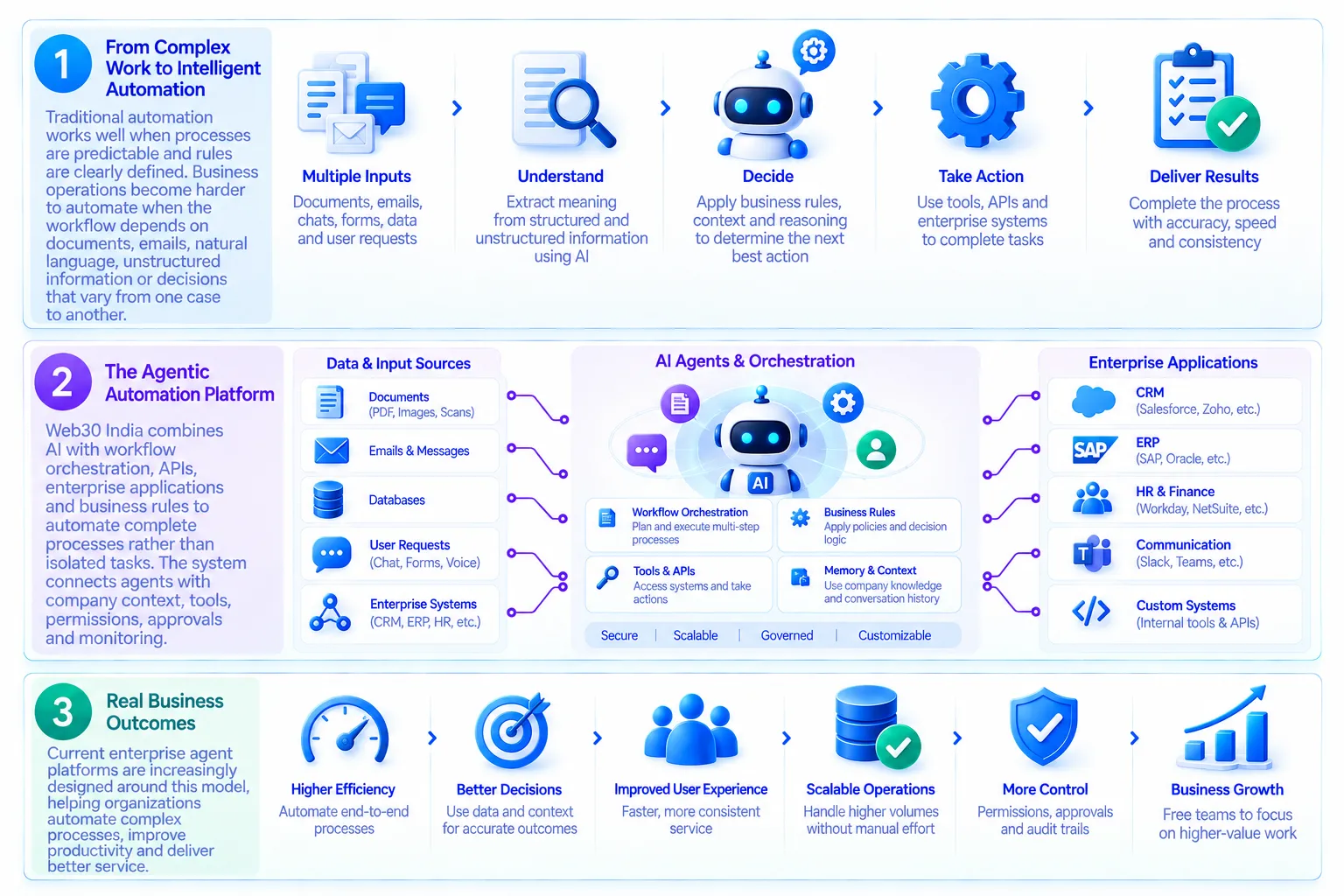
Traditional automation works well when processes are predictable and rules are clearly defined. Business operations become harder to automate when the workflow depends on documents, emails, natural language, unstructured information or decisions that vary from one case to another.
Web30 India combines AI with workflow orchestration, APIs, enterprise applications and business rules to automate complete processes rather than isolated tasks.
Current enterprise agent platforms are increasingly designed around this model, connecting agents with company context, tools, permissions, approvals and monitoring.
Combine AI with workflow engines to automate processes that involve documents, decisions, routing and multiple business systems
Deploy AI agents that can perform multi-step tasks, use approved tools and move workflows forward with defined controls.
Extract information from invoices, applications, contracts, forms and other documents and route the resulting data into business workflows.
Automate customer requests, ticket classification, information retrieval, case routing and selected service actions.
Automate repetitive finance, reporting, reconciliation, approval and administrative workflows.
Automate lead qualification, research, CRM updates, follow-ups, content workflows and sales operations.
AI automation can interact with business systems and perform real actions. Permissions, approvals, monitoring and clear boundaries therefore need to be designed into the workflow. Enterprise agent platforms increasingly provide role-based access, approval checkpoints, monitoring and audit controls for this reason.
Authenticate users and automation services and control access based on roles and workflow requirements.
Define which applications, APIs, functions and records an AI workflow can access.
Protect business documents, customer information, employee data and other sensitive information used during automation.
Apply instructions, validation rules and workflow constraints to limit inappropriate or unintended AI behavior.
Require human approval before sensitive actions such as financial operations, external communications or critical record changes.
Track workflow executions, AI decisions, tool calls, approvals, failures and system actions.
Restrict specific functions rather than granting broad system access.
Stop or route workflows to human teams when confidence, data quality or business rules are not sufficient.
Separate development, testing and production workflows with appropriate access controls.
Maintain useful records of what was processed, which actions were performed and where human intervention occurred.
A schedule, event, document, email, user request or system event starts the automation.
The workflow gathers the relevant documents, records, messages or business data required for the task.
AI interprets the information, identifies intent, extracts data and determines the next appropriate workflow step.
AI recommendations or decisions are evaluated against business rules, permissions and required confidence thresholds.
The workflow invokes approved APIs, applications, tools or automation services to complete the required action.
The result is recorded, the user or team is notified where necessary and exceptions are routed for human review.

Automate lead qualification, record updates, customer research, follow-ups and sales workflows.
Connect invoices, purchase orders, financial records, approvals and operational processes.
Automate workflows across email, collaboration platforms, messaging systems and internal communications.
Process documents, retrieve information and route extracted data into downstream workflows.
Automate ticket classification, routing, knowledge retrieval, incident workflows and operational tasks.
Connect AI workflows with internal applications, third-party services, databases and custom business systems.
Automate invoice processing, document extraction, reconciliation workflows, approval routing and financial reporting support.
Classify requests, retrieve customer information, route cases and automate selected service workflows.
Research prospects, qualify leads, update CRM records, prepare account information and automate follow-up workflows.
Automate employee requests, document processing, onboarding workflows, policy assistance and internal HR operations.
Classify service requests, gather diagnostic information, route incidents and automate approved operational tasks.
Process vendor information, compare documents, route purchase requests and support approval workflows.
Extract and validate information from contracts, applications, forms, invoices and other business documents.
Collect information across systems, prepare summaries, identify changes and generate structured operational reports.





Map the existing process, identify repetitive work, decision points, exceptions, dependencies and measurable outcomes.
Determine which parts should be automated through deterministic workflows, AI, agents, RPA or a combination of approaches.
Define triggers, AI components, business rules, integrations, approval points, data flows and exception paths.
Build the workflow orchestration, AI processing, business logic, integrations and required user interfaces.
Connect enterprise systems and test workflow execution, data handling, AI responses, permissions and failure scenarios.
Establish approval gates, access controls, guardrails, escalation paths, auditability and operational monitoring.
Deploy the automation into the required business environment and establish production workflows.
Review workflow performance, exceptions, AI quality, operational outcomes and user feedback to continuously improve the automation.
Explore practical insights on AI automation, intelligent process automation, AI agents, workflow orchestration, RPA and AI, enterprise automation, AI-powered document processing, agentic workflows, business process automation and AI integration.
Everyone has very little or no knowledge about the Metaverse. What does it mean and how does it work? We might not...
Today, smart contracts are beneficial for companies. This in-depth guide goes into great detail about their unique...
Everyone must be aware of how important it is to have a website in order to make a mark in the IT business industry...
Welcome to the next gaming frontier, where virtual worlds collide with reality to create immersive experiences like...
DeFi is an innovative system that will fundamentally change global finance. In summary, DeFi is an open monetary sy...
Everyone has very little or no knowledge about the Metaverse. What does it mean and how does it work? We might not...
Today, smart contracts are beneficial for companies. This in-depth guide goes into great detail about their unique...
Everyone must be aware of how important it is to have a website in order to make a mark in the IT business industry...
Welcome to the next gaming frontier, where virtual worlds collide with reality to create immersive experiences like...
DeFi is an innovative system that will fundamentally change global finance. In summary, DeFi is an open monetary sy...
Everything you need to know about our enterprise blockchain engineering process, costs, security, and architectures.
Where connections are brewed, ideas percolate, and inspiration flows!
Let’s hear about your project. Drop us the details or send us a direct email
 24/7 Support